
What are challenge numbers?
Every numerology chart has two sides. There's what you're good at, your life path, your expression number, the natural gifts you came in with. And then there's what you need to learn. That's where challenge numbers come in.
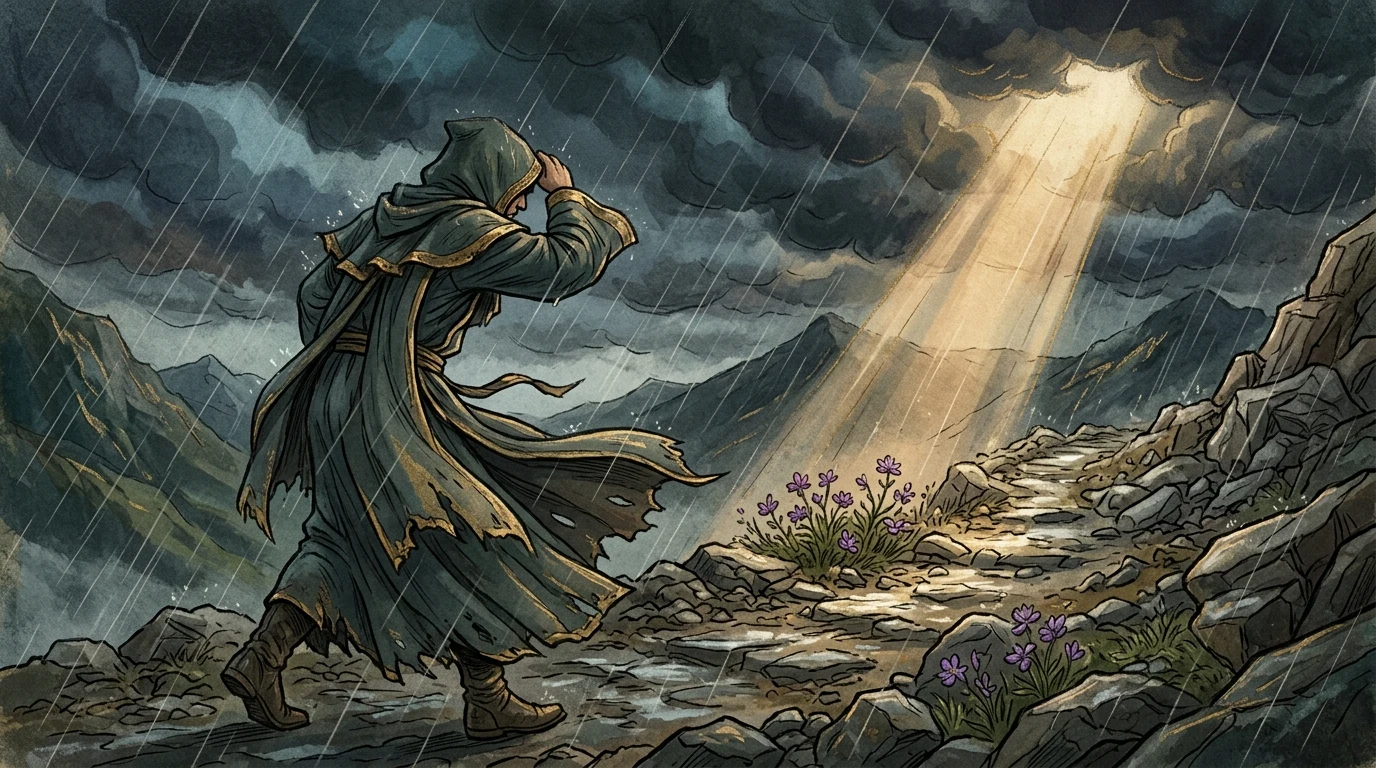
You have four challenge numbers, each one tied to a specific phase of your life. They're calculated from your birth date using subtraction (not addition like most numerology), and they tell you exactly what obstacles you'll face during each period. The thing is, "obstacle" sounds harsh. But these aren't punishments. They're assignments.
Challenge numbers pair directly with your pinnacle numbers. Same four cycles, same timing. But where pinnacles show you the opportunities available in each phase, challenges show you what's blocking your access to those opportunities. Think of pinnacles as the door and challenges as the lock. You work through the challenge, the pinnacle opens up.
And here's what makes challenge numbers genuinely useful: once you know what your current challenge is, you stop fighting the wrong battles. You can focus your energy on the actual growth area instead of wondering why certain things feel so hard.
How to calculate your challenge numbers
Challenge numbers use subtraction, not addition. That's why they only range from 0 to 8. You can't get a 9 through subtraction of single digits, and master numbers don't apply here.
Start by reducing your birth month, day, and year each to a single digit. Then:
- First Challenge = |Month − Day| (absolute difference, reduced to single digit)
- Second Challenge = |Day − Year| (absolute difference, reduced)
- Third Challenge = |First Challenge − Second Challenge|
- Fourth Challenge = |Month − Year| (absolute difference, reduced)
The vertical bars mean "absolute value," you always take the positive difference. If month is 3 and day is 6, the result is 3, not −3.
Worked example: Born March 15, 1990
Reduce each component:
Month = 3 (March)
Day = 1 + 5 = 6
Year = 1 + 9 + 9 + 0 = 19, then 1 + 9 = 10, then 1 + 0 = 1
Calculate the four challenges:
First Challenge: |3 − 6| = 3
Second Challenge: |6 − 1| = 5
Third Challenge: |3 − 5| = 2
Fourth Challenge: |3 − 1| = 2
So this person's challenge sequence is 3, 5, 2, 2. Each one activates during its corresponding life phase. Want to calculate all five of your core numbers? Try the numerology calculator.
The four challenge cycles
Your four challenges don't all hit at once. They activate in sequence, and the timing matches your pinnacle cycles exactly. The start of your first pinnacle is calculated as 36 minus your life path number, and each subsequent cycle runs for nine years.
First Challenge (Birth to early 30s)
This is the challenge of youth. It shapes your early struggles, the things that felt inexplicably hard when you were growing up. Many people don't even recognize this challenge until they look back on it later. It's foundational. The lessons here set the stage for everything that comes after.
Second Challenge (Early 30s to early 40s)
This challenge arrives as you're building your adult life. Career decisions, relationship patterns, identity questions, the second challenge sits underneath all of them. It's often the period where you start noticing the pattern. "Why does this keep happening to me?" That repeated friction is your second challenge doing its work.
Third Challenge (Early 40s to early 50s)
The third challenge is derived from the first two, and it's often the most intense. This is your midlife growth period, the phase where the lessons from your first two challenges combine into something deeper. People who do the work here often experience a real shift in self-awareness. It's not a crisis. It's a recalibration.
Fourth Challenge (Early 50s onward)
Your final challenge runs for the rest of your life. It represents the long-term growth area, the lesson that stays with you. But by this point, you've had decades of practice. Most people find that the fourth challenge feels less like a struggle and more like a familiar teacher. You know it well enough to work with it consciously.
The exact timing depends on your life path number. But the sequence is always the same: four phases, four challenges, each one building on the last.
Challenge number meanings
Challenge numbers only go from 0 to 8. Since they're calculated by subtraction, 9 is mathematically impossible. And master numbers don't apply to challenges. This is strictly single-digit territory.
The Choice Challenge
All challenges and none
This is the rarest challenge number, and paradoxically, it's the hardest. A challenge of 0 means no single weakness dominates your life during that cycle. You have access to all the challenges and none of them. Sounds great, right?
Here's the thing: when there's no obvious signpost telling you what to work on, you have to choose your own growth direction. And that requires real self-awareness. Nobody's going to hand you a clear lesson. You have to find it yourself. The 0 challenge asks you to look inward without a map. Most people with this challenge report feeling like they should be working on something but can't quite name it. That's the assignment: figure out which challenge to take on, and then take it on.
The Independence Challenge
Standing up without bulldozing
The 1 challenge is about learning to stand up for yourself without steamrolling everyone around you. You either assert too much or not enough, and you'll swing between both extremes before finding the middle.
What that means in practice: you might avoid confrontation entirely and let people walk over you. Or you might overcorrect and come across as aggressive or domineering. The growth area is finding the balance between independence and consideration. You're learning that having a backbone and having empathy aren't mutually exclusive. Once this clicks, you become someone who can lead without alienating people.
The Sensitivity Challenge
Holding your ground in relationships
The 2 challenge is about not losing yourself in other people's needs. You're naturally tuned into what others want, and your instinct is to accommodate. But accommodation without boundaries is just people-pleasing, and it leaves you empty.
The growth here is developing backbone without losing sensitivity. You don't need to stop caring about people. You need to include yourself in the group of people you care about. This challenge shows up most in close relationships, partnerships, family, close friendships, where the pressure to keep the peace is strongest. Once you work through it, your sensitivity becomes a superpower instead of a vulnerability.
The Expression Challenge
Finding your authentic voice
The 3 challenge is about learning to express yourself authentically. And it shows up in one of two ways: you either talk too much about nothing, or you hold back what actually matters. Both are avoidance strategies.
What's underneath is self-doubt about your creative voice. You're not sure your real thoughts and feelings are worth sharing. So you fill the space with chatter, or you go quiet. The growth is learning that what you have to say matters, and that saying it clearly, without performing or hiding, is enough. Once this challenge resolves, you become genuinely articulate. Not flashy. Real.
The Discipline Challenge
Building without rigidity
The 4 challenge is about embracing discipline without becoming a control freak. You're learning to build things, systems, habits, structures, but the trap is making the structure the point instead of the tool.
This can show up as either extreme: total disorganization (avoiding structure because it feels restrictive) or rigid overcontrol (clinging to routine because uncertainty feels threatening). Organization is the tool, not the goal. The growth is learning to create order that serves your life instead of ruling it. People who work through the 4 challenge become incredibly reliable without being inflexible.
The Freedom Challenge
Using freedom wisely
The 5 challenge is about not running from every commitment that feels uncomfortable. Change is healthy. Escape is not. And during this challenge cycle, you're learning to tell the difference.
You might quit jobs too early, leave relationships before giving them a real shot, or constantly chase the next new thing because staying put feels suffocating. The growth isn't about giving up freedom. It's about using it wisely. Real freedom includes the freedom to stay, to commit, to build something that takes time. Once you get this, you stop confusing restlessness with independence.
The Responsibility Challenge
Nurturing without martyrdom
The 6 challenge is about caring for others without neglecting yourself. You feel responsible for everyone's wellbeing, and you'll stretch yourself impossibly thin trying to fix things for people who didn't even ask for help.
You can't pour from an empty cup, and that's not just a cliche, it's your specific lesson. The growth here is learning that self-care isn't selfish. That sometimes the most loving thing you can do is let someone struggle through their own problem. And that your worth isn't measured by how much you sacrifice. People who resolve the 6 challenge become genuinely nurturing, generous without resentment, helpful without burning out.
The Trust Challenge
Trusting your inner knowing
The 7 challenge is about not hiding behind intellect to avoid emotion. You're smart. You analyze everything. But analysis is useful. Emotional avoidance disguised as analysis is not.
This challenge often shows up as isolation. You withdraw into your head, overthink decisions, and distrust anything you can't logic your way through. The growth is learning to trust your inner knowing, the gut feeling, the intuition, the thing you sense before you can prove it. You don't have to stop thinking. You just have to let feeling sit at the same table. Once this resolves, your analytical mind becomes paired with genuine wisdom instead of running on its own.
The Power Challenge
Handling power and money wisely
The 8 challenge is about not letting material success define your worth. You're drawn to achievement, status, and financial security, and there's nothing wrong with any of that. But when your self-image depends on your bank balance or your title, you've given your power away to external things.
Authority earned through service lasts. Authority grabbed for ego doesn't. The growth here is learning to handle power and money as tools rather than scoreboards. This challenge can also show up as fear of financial success, an unconscious belief that money is bad or that powerful people are corrupt. Either extreme misses the point. Once you work through this, you can build real material abundance without it owning you.
How challenges and pinnacles work together
Challenges and pinnacles aren't separate systems. They're two halves of the same cycle. Every life phase has both a pinnacle (the opportunity) and a challenge (the obstacle). You need both to understand what's actually happening in any given period.
Say your second pinnacle is 3 (creativity, self-expression) and your second challenge is 1 (independence). What that means is: the energy of that period supports creative work and communication, but you'll only access it fully once you learn to trust your own voice and stop waiting for permission. The challenge is the price of admission to the pinnacle.
This is why looking at challenges alone can feel discouraging, and looking at pinnacles alone can feel confusing. "Why am I not experiencing this supposed opportunity?" Often because the corresponding challenge hasn't been addressed yet. Work through the challenge, and the pinnacle starts to open. They're designed to function as a pair.
Frequently Asked Questions
What are challenge numbers in numerology?
Challenge numbers are four specific obstacles derived from your birth date using subtraction. Each one maps to a phase of your life and tells you what you need to work through during that period. They range from 0 to 8, and they pair directly with your four pinnacle cycles. Pinnacles show opportunities. Challenges show what's standing between you and those opportunities.
How do I calculate my challenge numbers?
You need your birth month, day, and year, each reduced to a single digit. First Challenge = |Month − Day|. Second Challenge = |Day − Year|. Third Challenge = |First − Second|. Fourth Challenge = |Month − Year|. For example, born March 15, 1990: Month = 3, Day = 6, Year = 1. Challenges: 3, 5, 2, 2.
What does challenge number 0 mean?
Challenge number 0 is the rarest and, paradoxically, the hardest challenge. It means no single weakness dominates your life during that cycle. The difficulty is that there's no obvious signpost telling you what to work on. You have to choose your own growth direction. It requires real self-awareness because nobody's going to hand you a clear lesson. You have to find it yourself.
How are challenge numbers different from pinnacle numbers?
Pinnacle numbers and challenge numbers cover the same four life phases and use the same timing. But they show opposite sides of the same coin. Pinnacles reveal the opportunities and energy available to you during each cycle. Challenges reveal the specific obstacles you need to overcome to access those opportunities. Think of pinnacles as the door, and challenges as the lock.
Can challenge numbers change?
Your four challenge numbers are fixed from birth. They don't change. But you move through them in sequence as you age, just like pinnacle cycles. The challenge you're actively working through shifts as you enter a new life phase. The timing follows the same pattern as your pinnacles, which is based on your life path number.
Are challenge numbers negative?
No. The word "challenge" sounds negative, but these numbers aren't bad news. They point to specific growth areas, the skills and qualities you're here to develop. A challenge number of 1 doesn't mean you'll fail at independence. It means learning independence is your assignment for that period. Challenges are the curriculum, not the grade.