
What karmic debt 16 means
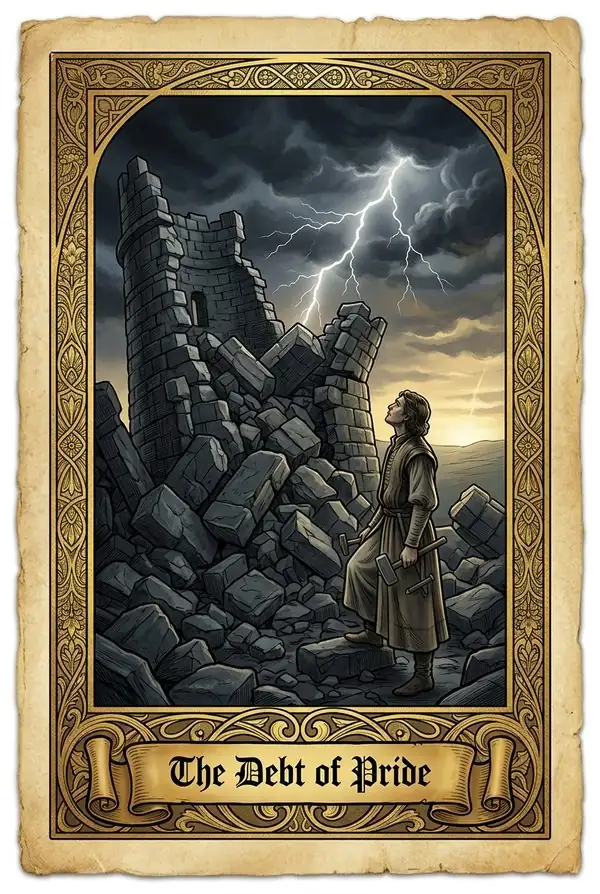
Karmic debt 16 reduces to 7 - the number of inner wisdom, spiritual seeking, and solitary reflection. But getting to 7 through 16 involves what numerologists call the 'tower moment.' The ego structures you've built - your identity, your reputation, your sense of who you think you are - get disrupted. Sometimes dramatically.
The past-life pattern behind 16 is ego inflation. Vanity. Using charm, beauty, status, or intellectual superiority to elevate yourself at others' expense. And the karmic response isn't punishment - it's correction. The universe keeps knocking down the false versions of yourself until you're willing to find out who you actually are underneath all of it.
This is probably the most intense karmic debt number. The 13 and 14 lessons are about effort and freedom - challenging but navigable. The 16 lesson is about identity itself. Who are you when your title is gone? When your looks fade? When the thing you were most proud of disappears? The 16 forces that question.
But here's what most descriptions of 16 get wrong: this isn't just destruction. It's renovation. The ego structures that fall weren't serving you anyway - they were keeping you from the real spiritual depth that 7 energy wants to reach. Once the false floor gives way, you find something solid underneath. Something genuine. And that's worth more than anything the ego was protecting.
How to know if you have it
Karmic debt 16 shows up when any of your core numbers reduce through 16 on the way to 7. In the life path, it means your entire life direction involves ego dissolution and spiritual rebuilding. In the expression number, it affects how you express yourself and what you're known for. In the soul urge, the ego lesson lives in your deepest desires.
Not every 7 carries karmic debt. Numbers that reduce through 25 or 34 to reach 7 don't have the 16 imprint. The 1 and 6 need to appear specifically as 16 in the reduction sequence.
People with 16 karmic debt often report a pattern of building something up - a career, an identity, a relationship built on image - and then watching it come apart. The falls feel devastating in the moment. In retrospect, they're always the doorway to something more real.
The life lessons of 16
The central lesson of 16 is learning who you are when you strip away everything external. Not your job title, not your appearance, not your social status, not the narrative you've built about yourself. You. The raw, undecorated version. The 16 lesson demands you get acquainted with that person.
This often happens through involuntary ego loss. A public failure. A relationship that exposed how much of your identity was wrapped up in being needed. A health event that changed how you look or function. A career collapse. The form varies, but the function is always the same: the false floor drops out.
What comes after the fall is where the real lesson lives. Once the ego structures are down, you have a choice. Rebuild the same false identity - or go deeper. Every time you choose depth over image, authenticity over performance, the 16 energy integrates a little more. The falls get less dramatic. The rebuilding gets faster.
And there's genuine beauty on the other side. People who've worked through 16 karmic debt develop a kind of humility that isn't performed or forced. It's the real thing - the humility of someone who knows exactly what they're worth because they've been stripped down to the essentials and found something solid there.
Strengths & challenges
What works for you
Once the ego cracks, what floods in is real spiritual awareness. Not surface-level spirituality or borrowed beliefs - the genuine article. People with integrated 16 energy often develop a depth of insight that others find remarkable.
The humility that comes from 16 isn't weakness or self-deprecation. It's the quiet confidence of someone who doesn't need external validation to know their worth. You've already lost the external stuff. What remained is yours.
Having been through ego collapse, you know something most people don't: you can survive the loss of everything you thought defined you. That knowledge gives you a fearlessness that people who've never been tested simply can't access.
Every fall teaches something the high ground couldn't. People with 16 energy who've done the work carry a quality of wisdom that's unmistakable - not intellectual, but experiential. They know because they've lived it.
What to watch
The tower moments aren't metaphorical. They're real losses - of status, of identity, of things you cared about. They hurt. And they tend to repeat until the lesson is received. The intensity lessens over time, but the early experiences can be genuinely destabilizing.
When who you think you are keeps getting dismantled, it's natural to feel lost. The question 'who am I really?' stops being philosophical and becomes urgent. Sitting with the not-knowing is uncomfortable but necessary.
When you've been knocked down, the instinct is to protect yourself by not building anything too high again. The challenge is learning to invest in new structures - relationships, careers, identities - without the fear of losing them controlling you.
The 7 energy underneath already leans toward solitude, and after ego collapses, the temptation to withdraw completely is strong. Some solitude is healthy and necessary. Complete isolation is the ego protecting itself from further exposure - and that's the pattern, not the solution.
Practical guidance
When the tower moment comes - and it will - don't rush to rebuild the same thing. Sit with the rubble for a while. Ask yourself what was real and what was performance. The instinct after a fall is to immediately reconstruct your identity, your reputation, your sense of self. Resist that. Give yourself time to discover what's actually worth rebuilding.
Develop a spiritual practice that's genuinely yours. Not borrowed, not performative, not something you do because it looks good. Meditation, journaling, time in nature, prayer - whatever connects you to something bigger than your ego. The 16 energy specifically needs a spiritual anchor, and the practice you build becomes that anchor.
Practice being ordinary. This sounds strange, but it's powerful for 16 energy. Let yourself be unremarkable in a conversation. Don't offer the smartest comment. Don't position yourself as special. Just be present. The ego will resist this intensely - which is exactly how you know it's working.
When you catch yourself building an identity around anything external - a job title, a relationship role, how you look, what people think of you - notice it. You don't have to destroy it. Just notice. That awareness creates a small gap between you and the ego structure, and in that gap is where the real 7 wisdom lives.
Common questions
What is karmic debt number 16?
Karmic debt 16 is a past-life pattern of ego inflation - using vanity, status, charm, or superiority to elevate yourself at others' expense. It reduces to 7 (spiritual seeking and inner wisdom), but the path through 16 involves repeated ego dissolution events. False identities get dismantled so something authentic can emerge. It's intense, but the spiritual depth it produces is genuine.
Why is karmic debt 16 called the 'tower number'?
The 'tower' reference comes from the Tarot (the Tower card) and describes how 16 energy works: structures built on ego or false identity collapse suddenly. It's not random destruction. It's the removal of things that weren't real so something solid can be built in their place. The tower falls so you can see the sky.
How do I know if I have karmic debt 16?
If any of your core numbers - life path, expression, soul urge, personality - reduce through 16 on the way to 7, you carry this debt. Not every 7 is a 16/7. The number has to specifically pass through the 16 combination during calculation. A pattern of identity-shaking events in your life is also a strong experiential indicator.
Is karmic debt 16 the worst karmic debt?
It's often described as the most intense, and that's fair - ego dissolution is genuinely painful. But 'worst' isn't the right frame. Every karmic debt has its own difficulty level, and what feels hardest depends on the person. The 16 lesson produces some of the deepest spiritual growth in numerology. The difficulty and the reward are proportional.
Can you avoid the tower moments with karmic debt 16?
Not entirely - but you can reduce their intensity. The more willingly you examine your ego attachments and let go of false identities on your own terms, the less dramatically the universe has to intervene. Voluntary ego work (therapy, meditation, honest self-reflection) is the proactive version of the lesson.
Does karmic debt 16 affect relationships?
It can show up as relationships built on image rather than substance - choosing partners based on how they make you look, or building a relationship identity that feels impressive but isn't emotionally real. The lesson in relationships is the same as everywhere else: drop the performance. Be genuine. Let the other person see the real you, not the curated version.